Quiz Designer App
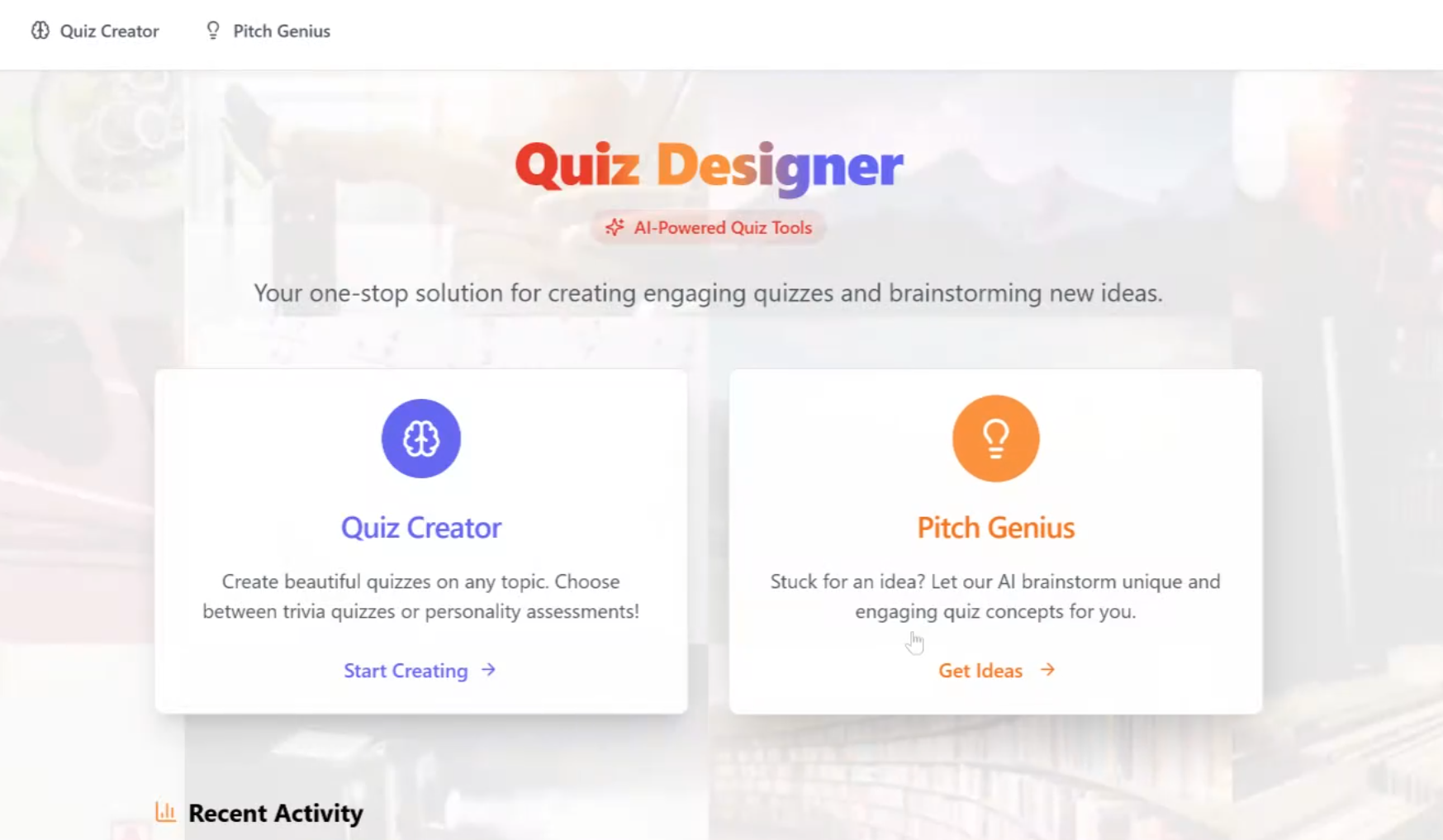
A bespoke AI-powered application for high-quality quiz production at scale
Role: Content Designer & Tool Builder Company: First Media Stack: Base44, custom GPTs, CSV/CMS integration
Overview
Quiz Designer is an AI-powered app I designed and built to make quiz production faster, more consistent, and higher quality. It replaced a messy, manual GPT process with a guided workflow that any creator on the team could use.
It started as a handful of custom GPTs I made to solve specific problems in the quiz pipeline. Once I saw how well the pieces worked, I consolidated them into a single coded application on Base44 with two modules: Pitch Genius for idea generation and Quiz Creator for building and checking the quizzes themselves.
The tool was one of several I built that helped scale quiz production from roughly one per day to over 500 per week with the same-size team, and helped grow content arbitrage into a multi-million-dollar monthly revenue line.
The problem
Before Quiz Designer, the team made quizzes by prompting GPT directly. That approach broke down at scale:
- Prompts were inconsistent, so quizzes came back with duplicated questions and factual errors.
- Cleanup was slow. Creators spent 8 to 10 minutes per quiz fixing CSVs and checking facts by hand.
- Idea generation had no structure, so writers struggled to be creative and efficient at the same time.
We needed a way to scale output without losing quality or burning out the team.
The solution
Quiz Designer turns the messy prompting process into a repeatable workflow. It has two modules.
Pitch Genius generates quiz pitch ideas. A creator chooses the quiz type (trivia, personality, or both) and a generation method (by topic, by an existing quiz, by category, or random and trending). They can also set how broad or niche they want the ideas, and how conventional or experimental. The tool returns ten pitch cards, each with a name, title, hook, and sample questions. A five-star rating on each pitch feeds back into the tool to improve future suggestions.
Quiz Creator builds the quiz step by step. The creator sets the basics (type, question count, voice), brainstorms topic groups, and then generates questions one at a time to avoid repetition. Every question gets an automatic fact-check and a fun fact. Creators can edit, reorder, and check character counts in the app, then export a clean CSV ready for the CMS.
What I did
I owned this project end to end, from the first GPTs through the finished application.
- Built the tool. I created the original custom GPTs, then designed and coded the consolidated app on Base44.
- Designed the workflow. I structured both modules around how creators actually work, breaking a big, error-prone task into smaller, guided steps.
- Wrote all the content. Every piece of copy in the app is mine: instructional text, tooltips, AI-directive templates, error and success states, help documentation, and the narration for the walkthrough video.
- Engineered the prompts. I wrote the system prompts and prompt frameworks that encode voice, structure, and quality standards, so the output starts on-brand instead of generic.
- Built in quality control. I added per-question fact-checking, semantic duplicate detection, and character-count monitoring so quizzes were accurate and mobile-safe on the first pass.
Key design decisions
A few choices made the biggest difference in quality and adoption:
- Topic grouping to beat repetition. Asking GPT for a 60-question quiz in one shot produced repeats and "forgetfulness." I had creators define topic groups first, then generate questions within each group. Duplicates dropped to under 2 percent.
- Per-question fact-checking. Instead of trusting a batch, every question is checked on its own, with the correction explained. This lifted first-pass accuracy to over 95 percent.
- Guidance with flexibility. Creators can skip steps, but the tool warns them when skipping might hurt the result. Smart defaults speed up the work without taking away control.
- Editable AI directives. Some stakeholders needed specific wording and phrasing. I built editable templates and fields so those requirements could be met without rewriting the workflow each time.
Impact
- Quiz production scaled from roughly 1 per day to over 500 per week with the same-size team.
- Average production time per quiz dropped from 10-plus minutes to around 6.
- First-pass accuracy rose to over 95 percent, with fact errors caught before reaching the CMS.
- The work helped grow content arbitrage into a multi-million-dollar monthly revenue line.
- The quizzes ran at a 110% ROI, roughly $200,000 in profit per month.
- It also supported turning the quizzes into a white-labelable B2B product, opening a new revenue lane beyond our own properties.
- Creator feedback centered on one theme: less grunt work, more ideation.
What I learned
- Clear language improves both the user experience and the AI's performance. The same clarity that helps a person follow a step helps the model produce a better result.
- Breaking a big prompt into smaller steps beats trying to get everything in one call.
- Writers want creative control, but they benefit from smart defaults that handle the repetitive parts.
- Internal tools deserve the same content design care as customer-facing products. The people using them are users too.